Few housing markets combine stability, depth and long-term appeal the way the United Kingdom does. And over the past few months, the market has demonstrated that resilience once again. Rather than reacting to economic strain or weakening fundamentals, buyers and sellers simply took a brief pause while awaiting the government’s Budget — a pattern that would feel familiar to Singaporeans, who are accustomed to policy clarity shaping market behaviour at home.
In both countries, buyers tend to be thoughtful and measured when major announcements are on the horizon. This kind of pause reflects confidence, not concern — a sign that households prefer making decisions with complete visibility rather than rushing into uncertainty. Now that the UK’s fiscal direction has been clarified, analysts note that sentiment is already beginning to stabilise, with many expecting 2026 to unfold on stronger footing.
For Singaporean buyers considering opportunities abroad, this moment highlights a reassuring truth: in transparent and well-regulated housing systems, short periods of quiet often precede renewed momentum. And with clearer signals now in place, the UK market may be entering a phase where confidence can build again.
What Really Happened in the UK Housing Market?
One recent Business Times report offers a useful snapshot of this dynamic. In the lead-up to the UK Budget, both buyers and sellers grew more cautious, resulting in softer enquiry levels and slower sales. But a temporary pullback in sentiment is very different from underlying structural weakness — and understanding that distinction is key.
A Sentiment Pause, Not a Structural Decline
Before the Budget was announced, there were rumours of possible adjustments:

Even though none of these were confirmed at the time, the mere possibility was enough to nudge some buyers and sellers into a holding pattern.
Once the Budget was released, however, something interesting happened: major homebuilders’ share prices rose 1–3% reversing the dip from the day before. This reaction alone shows that investors
interpreted the Budget not as damaging, but as clarifying.
In short: the issue wasn’t affordability.
It wasn’t oversupply.
It wasn’t economic weakness.
It was simply uncertainty.
What the Budget Actually Changed — and Didn’t Change
The Budget itself was more restrained than many expected. Crucially:
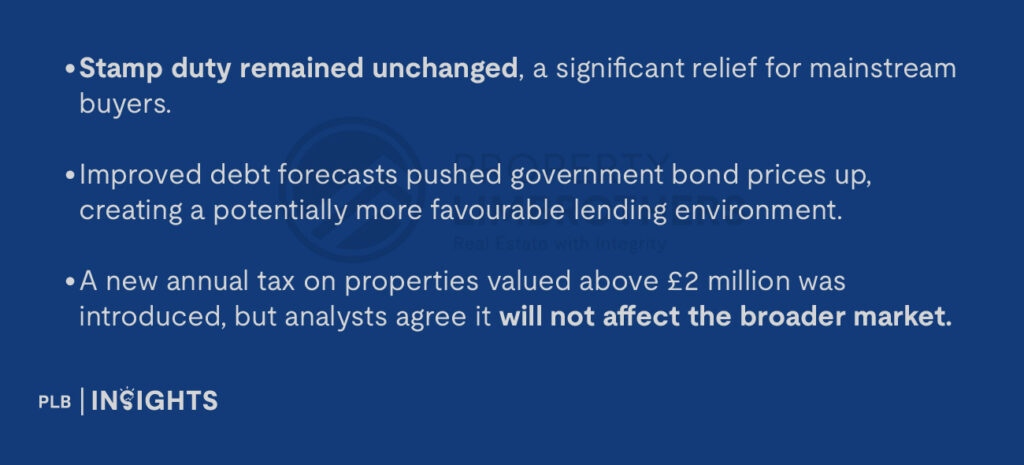
This new levy — £2,500 a year for homes worth over £2 million, and £7,500 for those over £5 million — touches the premium end of the market, particularly London. But such adjustments are not unusual in global cities, and the amounts represent a small fraction of overall holding costs at that price tier.
As Investec analyst Aynsley Lammin notes, “The reality is that the main part of the housing market is pretty unscathed.”
Why Analysts Expect a Recovery in 2026
With the Budget uncertainty now resolved, several indicators point to a more constructive 2026.
Pent-Up Demand Is Likely to Return
Both Investec and Barclays expect the next spring selling season — traditionally the strongest window for UK housing — to see renewed activity. Buyers who delayed their decisions for months may now feel comfortable re-entering the market.
Mortgage Rate Environment Turning More Favourable
One important outcome of the Budget was an improvement in the UK’s debt outlook. Rising bond prices lead to falling yields, which in turn influence long-term mortgage rates.
Expectations for lower Bank of England interest rates remain unchanged, further supporting affordability in the medium term. For buyers, this combination of improved visibility and potential rate relief creates a more stable environment.
Investors Are Voting With Their Wallets
Homebuilder shares — including Berkeley, Barratt Redrow and Persimmon — rebounded after the Budget, signalling confidence rather than concern.
When investors respond positively, it suggests that underlying demand, long-term fundamentals and project pipelines remain intact.
The Power of Expectation in Modern Housing Markets

The UK market’s recent dynamics highlight how sentiment can guide activity in a transparent and mature housing landscape.
Buyers Move When They Understand the Rules
A home purchase in the UK is a long-term commitment. When buyers sense that rules may change — taxes, transaction costs, reliefs — they often wait until they have clarity. This behaviour is rational and predictable.
Sellers Wait When the “Right Timing” Feels Unclear
If homeowners believe taxes may rise or market conditions may shift, they may delay listing their property. This reduces supply in the short term and creates a perception of inactivity.
Developers Slow Down Forward Sales Amid Uncertainty
Forward sales — which developers rely on for planning and financing — tend to soften when households adopt a cautious stance. This does not signal distress; it simply reflects a prudent response to evolving policy expectations.
In short, expectation shapes movement. And when expectations stabilise, demand typically follows.
Why the UK Remains Fundamentally Attractive

The key takeaway is that the mainstream UK housing market is largely unaffected. But beyond that, there are several long-term strengths worth highlighting.
A Major National Commitment to Build 1.5 Million Homes
The UK government has reiterated its goal of building 1.5 million homes before the next election. Equally important are plans to streamline planning rules — historically one of the biggest bottlenecks in the UK housing system.
A more efficient planning environment is positive for both supply and long-term market confidence.
Transparency and Rule of Law Support Buyer Confidence
The UK remains one of the world’s most transparent and well-regulated housing markets. Annual property levies, land taxes and rental income frameworks are clearly defined.
For international investors — including Singaporeans — this predictability remains a key attraction.
Long-Term Undersupply Continues to Support Values
Despite the government’s ambitious supply goal, the UK’s housing shortage remains a long-standing challenge. Persistent undersupply is one of the reasons values have held relatively firm even during economic slowdowns.
For buyers with multi-year horizons, this structural backdrop provides support for long-term price stability.

What This Means for Singaporean Buyers

The UK has consistently been one of the top overseas markets for Singaporeans, driven by education, rental demand, and diversification. The recent slowdown offers several takeaways.
A Pause Creates Visibility, Not Vulnerability
For many Singaporean households who prefer stable and predictable policy environments, the end of Budget uncertainty may actually make this a more comfortable period to evaluate opportunities.
A Good Window for Careful Assessment
Clarity following the Budget means Singaporean buyers can assess options with a steadier backdrop. During these more measured periods, buyers typically have space to review developments, understand long-term rental demand, and align purchases with their own timelines rather than market-driven pressures. Such phases often support more deliberate, informed decision-making.
The Long-Term Appeal of the UK Hasn’t Changed
The underlying factors that make the UK appealing remain intact:

Temporary sentiment dips do not erase these long-term fundamentals.
Why Confidence — Not Discounts — Will Shape 2026

The most important lesson from the UK’s recent pause is this: confidence drives markets.
The Budget Restored a Clearer Policy Roadmap
With a defined tax framework, homeowners and buyers can now make informed decisions.
Early Indicators Already Look Positive

Confidence often returns faster than transaction volumes reflect.
In Housing, Stability Is Often More Important Than Stimulus
The UK’s Budget did not introduce dramatic incentives, but it did remove uncertainty — and that alone may be enough to reset the market for 2026.
Conclusion: A Market Moving Forward with Greater Clarity
The recent period in the UK housing market reflects the thoughtful, steady behaviour that typically emerges when households await important policy announcements. In a transparent and well-regulated system, buyers naturally prefer to align decisions with the latest fiscal signals — a pattern that underscores the market’s maturity rather than uncertainty.
With the Budget now clearly set out, the environment appears more settled. Analysts anticipate a more active 2026, supported by clearer policy direction, stable financing conditions and the government’s ongoing commitment to improving planning processes and boosting housing supply.
For Singaporean buyers, this phase offers the benefit of greater visibility. It provides a chance to review the UK landscape with clarity, assess long-term fundamentals with less short-term noise, and make decisions with confidence. Throughout this period, the UK’s enduring strengths — from strong rental demand to its global-city status and long-established institutional stability — continue to underpin its position as one of the world’s most resilient and trusted housing markets.
Where uncertainty once prompted households to observe, renewed clarity now provides a stronger foundation for forward-looking decisions.
If you would like a clearer understanding of how these developments relate to your own plans, our sales consultants are available to offer informed guidance. Click here to get in touch with our team.