As we move through 2025, more landed homeowners are pausing before making one of the biggest housing decisions of their lives: whether to rebuild their home, opt for Additions and Alterations (A&A), or simply renovate what they already have.
Perhaps in the past, rebuilding was more often seen as the natural end point of landed ownership. Buy an old house, tear it down, and start afresh. Today, the decision is no longer that straightforward.
Construction costs remain elevated, timelines have stretched, regulations are more complex, and lifestyles have evolved. Heading into 2026, the more relevant question is no longer “Can I rebuild?” but “Should I rebuild — and is it the right move for my home and my plans?”
This article is written as a 2025 outlook for 2026, to help landed homeowners make clearer, more deliberate decisions before committing significant time, money, and energy.
The 2025 Reality That Will Shape 2026 Decisions
Construction costs are high, and likely here to stay
While the sharp post-pandemic spikes have moderated, rebuilding costs in 2025 remain meaningfully higher than pre-pandemic levels. Labour shortages, compliance requirements, and material pricing have created a new baseline rather than a temporary peak.
Looking ahead to 2026, expecting rebuilding costs to “come down significantly” may be unrealistic. The more likely scenario is cost stability at elevated levels, not a return to earlier benchmarks. For homeowners planning a rebuild next year, this means decisions should be made with today’s realities firmly in mind.
Timelines matter more than ever
Rebuilding is not just a financial commitment. It is also a time commitment.
In 2025, full rebuild timelines often extend well beyond initial expectations, especially once planning approvals, design changes, and unforeseen construction issues are factored in. These conditions are unlikely to ease materially in 2026.
Longer timelines translate into:

For many households, time has become just as critical a factor as cost.
Regulatory and approval complexity is not easing
Planning constraints, technical requirements, and approval processes have become more detailed rather than simpler. Owners of older homes are often surprised by how much additional work is required before construction even begins.
There is little indication that these requirements will loosen in 2026. For homeowners considering a rebuild, regulatory complexity needs to be part of the upfront decision, not an afterthought.
Rebuild, A&A, or Renovation: Understanding the Three Paths Clearly
Before deciding what to do in 2026, it is important to clearly distinguish between the three main options.
What a full rebuild really means in 2026
A rebuild involves demolishing the existing structure and constructing an entirely new home. It offers the greatest design freedom and the ability to fully customise layout, height, and internal flow.
However, rebuilding also comes with:

In 2026, a rebuild should be viewed as a long-term lifestyle and holding decision rather than a default upgrade.
What A&A can and cannot achieve
A&A sits between rebuilding and renovation. It allows owners to retain part of the existing structure while making structural changes such as extensions, additional floors, or reconfigured layouts.
Many homeowners assume A&A is always simpler. In reality, depending on scope, A&A can approach rebuild-level complexity, especially when structural reinforcement or major reconfiguration is involved.
That said, when scoped carefully, A&A can deliver substantial improvements with lower cost and shorter downtime than a full rebuild.
Minor renovations: the often underestimated option
Minor renovations focus on improving usability, comfort, and aesthetics without altering the building’s structural core. Kitchens, bathrooms, flooring, lighting, ventilation, and internal flow often fall into this category.
In 2025, many homeowners underestimate how transformative thoughtful renovation can be, especially when the home already has good bones.
When Rebuilding in 2026 Still Makes Sense

Rebuilding can still be worth it in 2026 — but only under the right conditions.
The structural condition genuinely limits the home
Age alone is not a reason to rebuild. Many older landed homes remain structurally sound.
Rebuilding tends to make sense when:
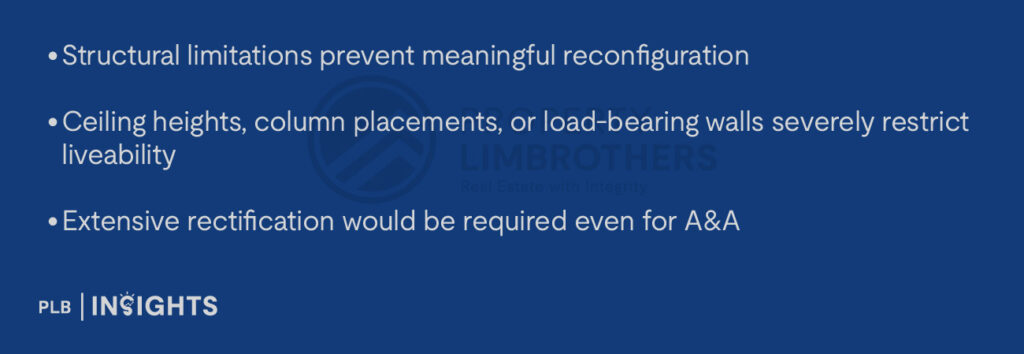
In such cases, rebuilding may be more efficient than attempting to “fix around” fundamental constraints.
The land value clearly outweighs the existing built form
Some homes sit on land where the value lies predominantly in the plot rather than the existing structure. In these cases, rebuilding can unlock the site’s full potential.
However, this applies selectively. If the existing home already aligns reasonably well with land value and neighbourhood context, rebuilding may not meaningfully change the home’s market position.
Household needs extend well into the future
Rebuilding makes the most sense for owners who are planning for the next 15 to 20 years.
Common motivations include:

If the rebuild is designed for long-term occupation rather than immediate gratification, its value becomes clearer.
The holding horizon supports the commitment
Rebuilding tends to favour longer holding periods. For owners considering selling in the near to medium term, the cost, time, and effort involved may not translate proportionately into value.
When A&A Is the Smarter Middle Ground Going Into 2026
For many homeowners, A&A represents a more balanced solution.
Situations where A&A works particularly well
A&A often delivers strong outcomes when:
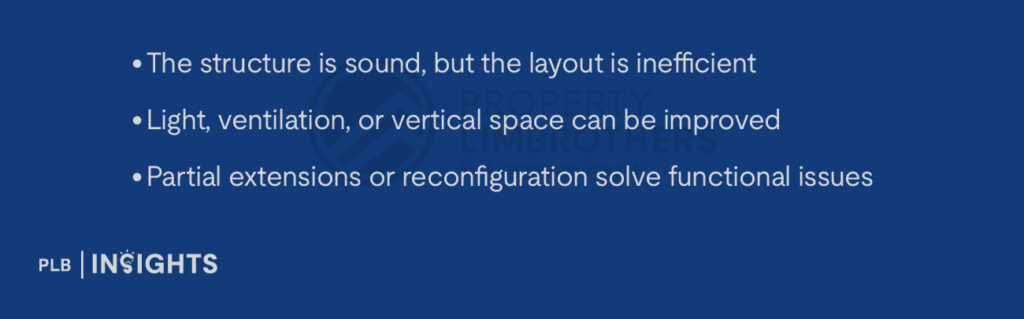
In such cases, A&A can achieve most of the benefits of a rebuild without starting from scratch.
Better balance between cost, time, and disruption
Compared to rebuilding, A&A typically involves:

As we head into 2026, this balance has become increasingly attractive to owner-occupiers.
Risks to be mindful of
A&A is not risk-free. Cost creep, approval assumptions, and structural surprises can still arise. Clear scoping and realistic expectations are essential.
When Minor Renovations Are Actually Enough
Perhaps the most overlooked conclusion in 2025 is that many homes do not need rebuilding or A&A at all.
When rebuilding becomes overkill
If a home has:

Then rebuilding may be solving the wrong problem.
In many cases, discomfort stems from dated finishes rather than fundamental flaws.
What occupants and buyers truly respond to
Both owner-occupiers and buyers consistently value:

Thoughtful renovation can deliver these without excessive intervention.
Avoiding the sunk-cost trap
For owners considering a future sale, minor renovation often strikes the best balance between improvement and prudence. Over-investing rarely broadens the buyer pool meaningfully.
Cost Comparisons With a 2026 Lens
Rather than fixating on precise figures, it is more useful to think in relative terms.

It is also important to account for:

These factors often tip the decision more than headline construction numbers.
Will Rebuilding Still Translate Into Value in 2026?
Rebuilding should rarely be justified purely on resale.
While a rebuilt home may command attention, the market increasingly rewards:

In some cases, a rebuilt home may actually narrow the buyer pool by pushing price beyond comfortable thresholds.
A Practical Pre-2026 Decision Checklist
Before committing, homeowners should ask:
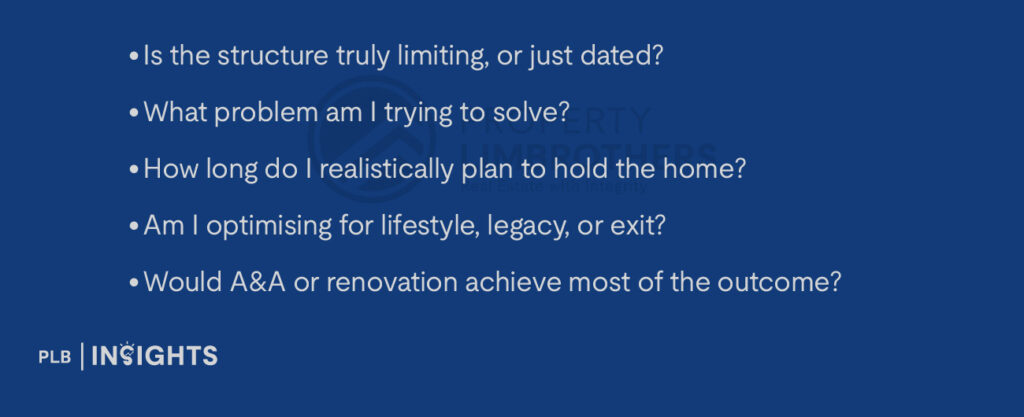
Clear answers often lead to clearer decisions.
Conclusion: Rebuilding May Still Be Worth It in 2026 — But Only With Clarity
As we look ahead from 2025 into 2026, rebuilding remains a valid option — but no longer a default one.
The better question is not “Is rebuilding still worth it?” but “Is rebuilding right for this home, this household, and this holding horizon?”
For many owners, the smartest decision may lie in thoughtful A&A or well-executed renovation. For others, rebuilding remains the right long-term move.
Clarity, rather than convention, will define the best outcomes in 2026.
If you are weighing whether to buy, sell, rebuild, or hold a landed home heading into 2026, speak with our sales consultants to understand how these market dynamics apply to your specific situation.
Thank you for reading, and stay tuned! For more detailed insights regarding the landed property market, join our Landed VIP Club and stay updated with the latest market trends and expert advice.